
Type In Your First Name & EmailAnd Get FREE Access
PRIVACY: I promise to keep your contact information private with me and never shared, rented, sold, or otherwise made available to anyone else. Brent
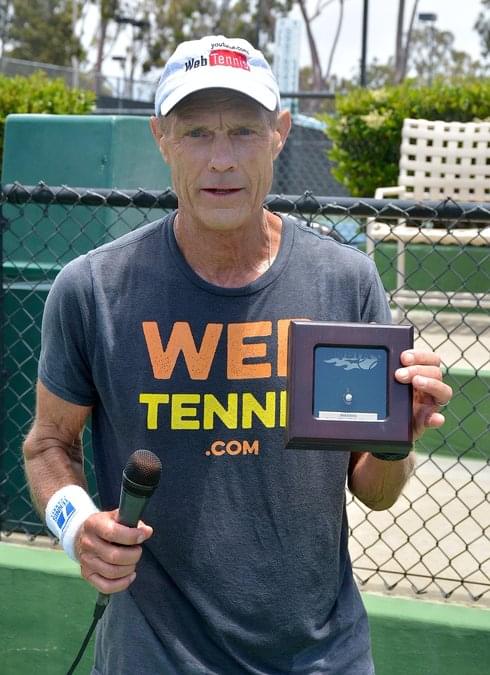
Brent Abel
- 21 USA Gold Balls in Singles & Doubles (so far)
- 2023 ITF World Doubles Champion (Mallorca, Spain)
- Selected to 5 USA World Cup Teams
- End of 2023 Rankings
- #1 USTA Singles & Doubles (75s)
- #1 ITF World Doubles (75s)
- #3 ITF World Singles (75s)
- Founder WebTennis.com 1999
- Creator 'What's The Right Shot?' 2012
- Co-Creator Gold Ball Hunting 2020
- 45+ Years Coaching Career
Brent Abel's WebTennis.com
CONTACT: brent@webtennis.com
Type In Your First Name & EmailAnd Get FREE Access
PRIVACY: I promise to keep your contact information private with me
and never shared, rented, sold, or otherwise made available to anyone else. Brent
"When I started working with Brent, I had been playing tennis for over fifty years. I’d worked with dozens of coaches and watched countless instructional videos.
I’d played hundreds of league and tournament matches. I had accepted that I wasn’t going to hit a Sampras serve or a Rafa forehand—or anything close. I figured my game had reached its lifetime peak and was destined to slowly decline with age.
Then I met Brent—gold ball winner and renowned coach.
He told me my strokes were "good enough" and said he’d actually like to have my service motion, but what I needed was to improve my mental game.
That began a whole new path for me—one focused not on swing tech, but on the mental game. I am beginning to understand the game more deeply; how to prepare, how to think on the court, how to compete with confidence.
Working with Brent has improved my game immeasurably and my enjoyment of the game and "the process".
My mental approach, confidence, and ability to think on the court have all grown steadily. Even better, I now know there’s still so much more to learn, and that my game can continue to improve, and that is really exciting.
Now, if you’re in the 65s division, please don’t work with Brent—I really don’t need you getting better on the other side of the net. But if you’re in any other age group, I encourage you to get on the path of improvement. It’s not easy, and it takes work, but the rewards are real—and deeply satisfying."
Dan Fisher, Ann Arbor., MI
"I used to be frequently nervously on-edge and ride the mental/emotional roller-coaster of highs and lows, depending on the day or a specific opponent(s) or distracting circumstances, or even isolated games..
Brent's advice on the mental aspects of tennis has greatly increased my confidence, clarity, and calmness, and that, in turn, has produced MUCH better results as far as consistent and winning tennis.
I now have a daily “script” of winning mindset affirmations and emotive visualizations that provide solid grounding for my tennis identity,
Such enabling thoughts echo in my consciousness at key competitive moments.
Brent persuaded me of the importance of a BPR routine, and provided a template, for every point. This helps keep me on an even-keel with clarity and focused specific intention.
His emphasis on a first-choice safe target simplifies the game, helps me win the “unforced errors” stat, and promotes greater confidence. It calms my previously noisy and critical mind. I can focus more on what I want to achieve, rather than self-fulfilling prophecies about what I want to avoid.
Winning now is the norm; and when I don't win, I learn, and then grow (also a win!).
Thanks, Brent!!
P.S. Now approaching 72; sure wish I had absorbed some of Brent's teaching much earlier.
Don P., Florida
Brent Abel's WebTennis.com
CONTACT: brent@webtennis.com
Brent Abel
- 21 USA Gold Balls in Singles & Doubles (so far)
- 2023 ITF World Doubles Champion (Mallorca, Spain)
- Selected to 5 USA World Cup Teams
- End of 2023 Rankings
- #1 USTA Singles & Doubles (75s)
- #1 ITF World Doubles (75s)
- #3 ITF World Singles (75s)
- Founder WebTennis.com 1999
- Creator 'What's The Right Shot?' 2012
- Co-Creator Gold Ball Hunting 2020
- 45+ Years Coaching Career